
 Apply
Apply Inquire
 Give
Give Pay My Tuition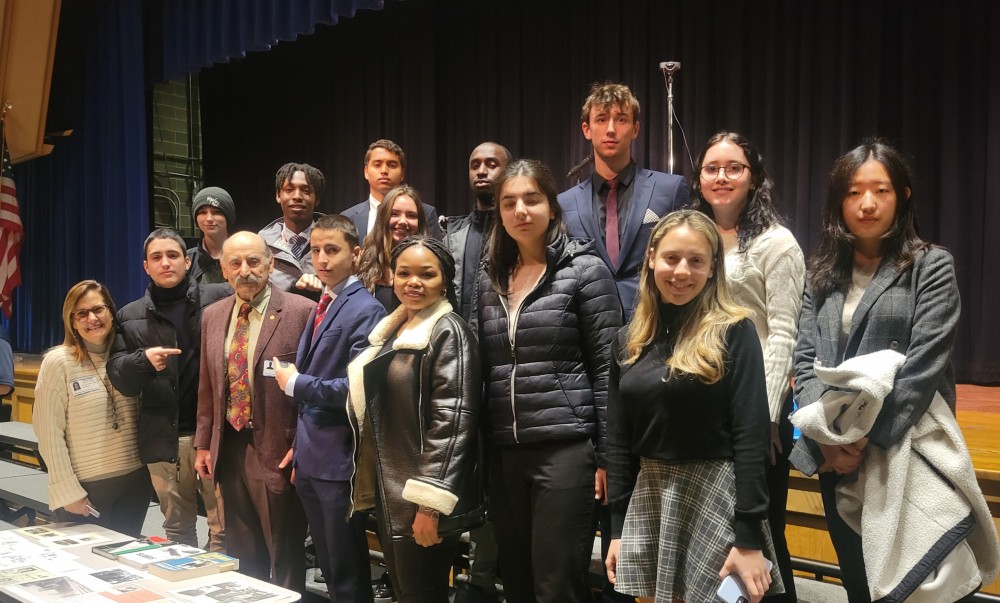
Hoosac Students Meet Holocaust Survivor Ivan Vamos and Learn First Hand About Courage and Resiliency
April 14th, 2022


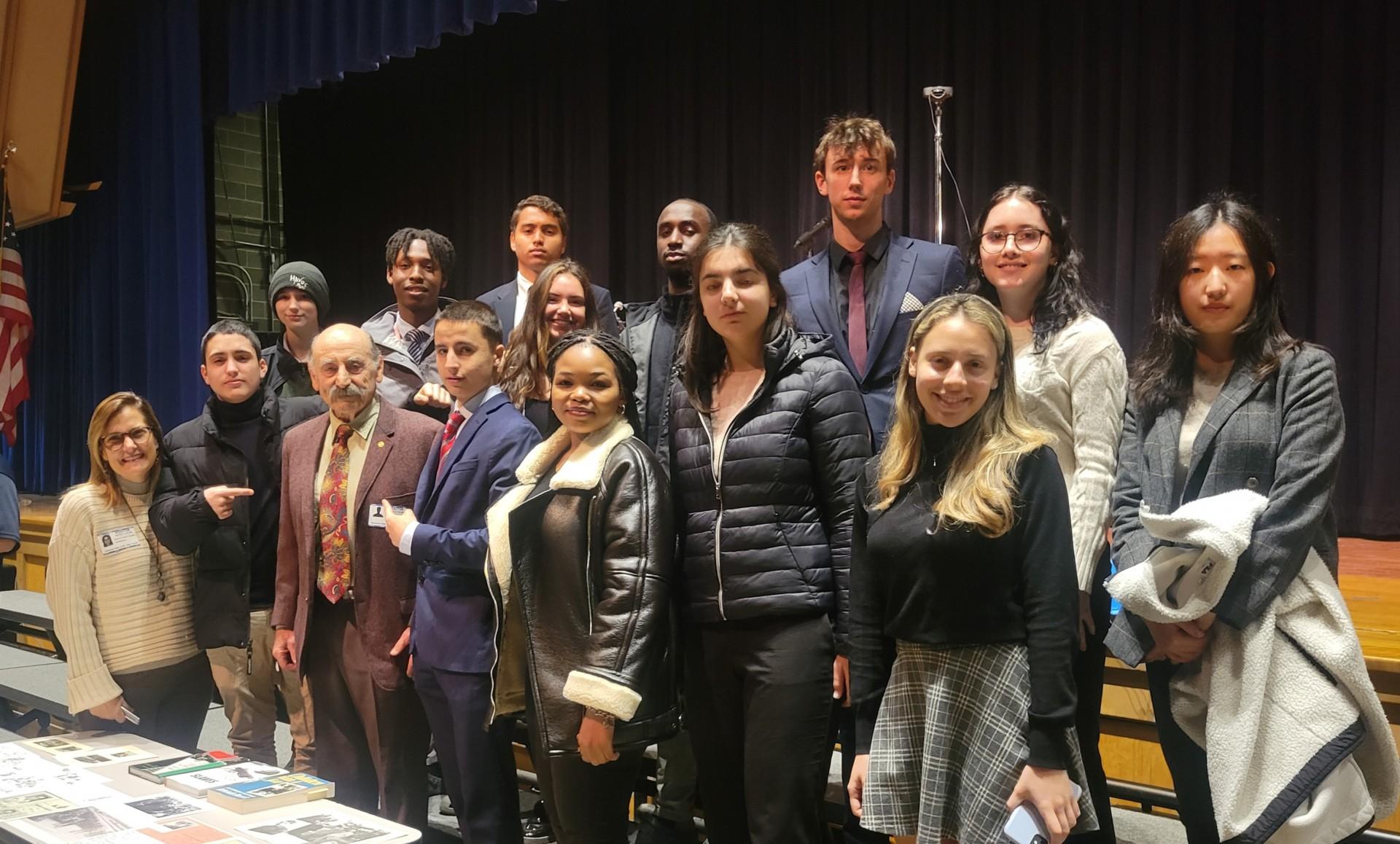
Hoosac Students had the great privilege to attend Ivan Vamos' guest lecture on Wednesday, April 14th, where Vamos told his personal and family accounts of living in Hungary during the beginning and through World War II.
By the age of six, Vamos, who was born in Budapest, had seen his father sent into slave labor and killed, and hid with his mother, Ilona, to avoid deportation and worse.
In 1943, Vamos’ grandfather, a decorated WWI Austro-Hungarian officer, was called up by the military, accused of disloyalty and beaten to near-death, so Vamos and his mother decided to hide. Carrying false papers, she and Ivan pretended to be refugees from the Russians, and found a place in a rural area until spring 1944.
In 1944, alarmed by roundups of people in the countryside, the pair walked back to Budapest. They arrived at a “protected house,” likely one of the houses under Swedish sponsorship, as bravely arranged by famous Swedish architect Raoul Wallenberg. They stayed for a few weeks until a German takeover of the Hungarian government in March 1944. This invasion put the ultra-rightist Hungarians, called Nyilas, in charge of the country by the fall. The Nyilas herded all those in the protected houses elsewhere to boxcars headed for the extermination camps.
As thousands were headed for deportation, Ivan’s mother grabbed his hand, and took the risk of running into a group of on-lookers on the sidewalk. Running then walking in haste, and after a few close calls, they ducked into a bombed-out apartment house. Fortunately, they still carried a hidden bag of split peas Ivan’s mother obtained months before in the countryside, and water remained in some toilet flushing tanks, allowing for their survival. They continued to hide in several of these ruins for months until the Russians arrived to liberate the Hungarians in February 1945.
“My mother was very unique and innovative and such a brave woman,” Vamos said after the assembly.
After the war, Vamos’ mother immigrated to the United States after marrying a Czechoslovakian man. Vamos was still Hungarian, and the quota for Hungarians to immigrate to the U.S. was much lower, so Vamos was forced to remain in Hungary for the next year.
He got a job on a farm at the age of 10 and eventually immigrated to the United States in the fall of 1947 and became a U.S. citizen in 1953.
He worked his way through a doctorate in Public Administration at SUNY Albany and served in the U.S. Navy as a shipboard engineering officer, as Port Control Officer for Reykjavik Iceland, and Officer in Charge of a radar site in northeast Iceland. He also worked as an Engineering Geologist / Geophysicist in the U.S. and Australia.
Now at 84 years old, Vamos takes pride in being able to tell his story, first-hand, to students learning about World War II and the Holocaust.
“It’s a privilege and I appreciate the teachers and the schools,” Vamos said. “Being able to tell my story to so many different people – members of the FBI and the Watervliet Arsenal as well – it’s a learning process no matter who I’m talking to.”
Livia Gomes '23 who attend the assembly had this to add: "The emotional resilience from Mr. Vamos was something very admirable... Learning about the Holocaust from the point of view of an individual who has actually witnessed those events is a unique and enriching experience, helping us to reflect on one of the biggest atrocities of human history."